
Meta Ads vs Google Ads for Education Institutes in India: Which One Actually Gets You Admissions?
You are spending money on ads. Students are still calling to ask if seats are available. And your counsellor is doing follow-up calls with leads who have already joined somewhere else.
The problem is not your fees. It is not your course. It is that you are running the wrong platform for the wrong goal.
Meta Ads and Google Ads both work for education institutes. But they work completely differently. And if you pick the wrong one at the wrong time, you burn budget and blame marketing.
This guide breaks down exactly how each platform works, which one is right for your situation, and what most institutes get completely wrong.
The fundamental difference most institutes miss
Think of it this way.
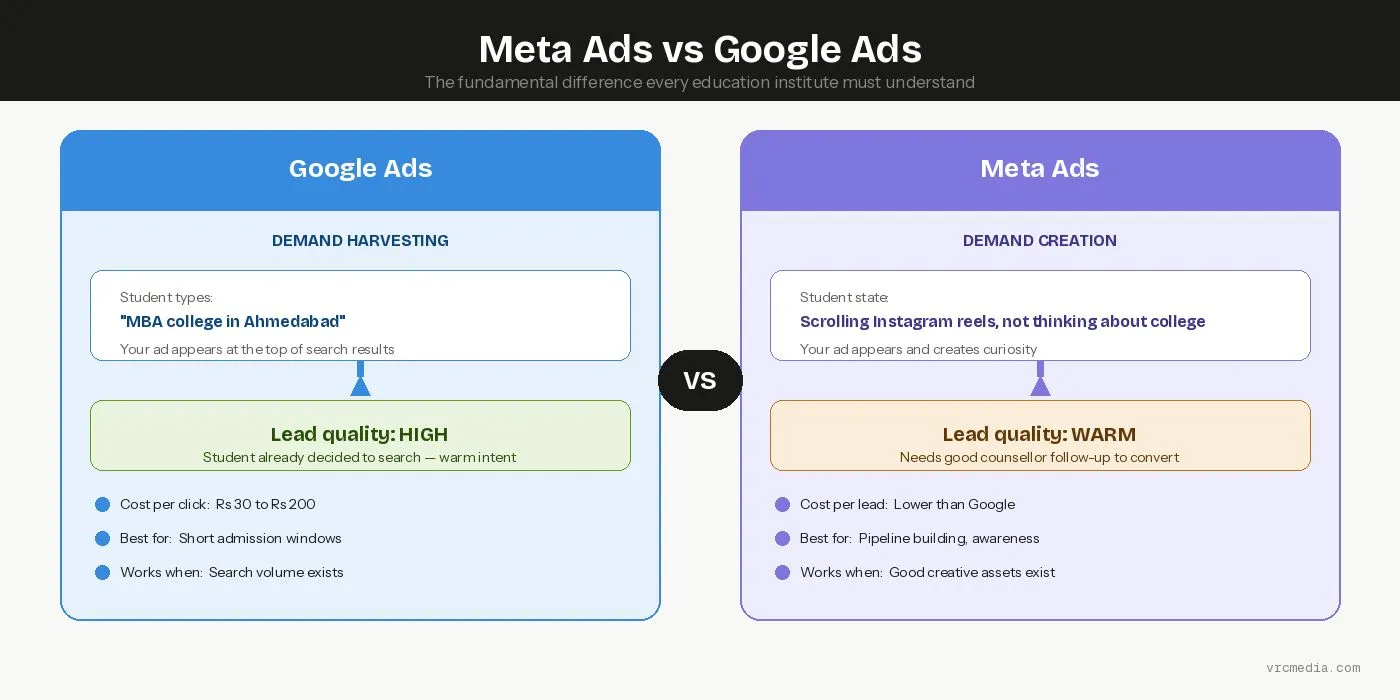
Google Ads is like a door that opens only when a student is already knocking. They have typed “MBA college in Ahmedabad” or “best coaching for JEE in Surat” and they are actively searching. You show up. They click. If your landing page is good, they fill the form.
Meta Ads is the opposite. You show up in a student’s feed while they are watching reels or scrolling through friends’ photos. They were not thinking about admissions. You made them think about it.
One is demand harvesting. The other is demand creation.
Both are valuable. But they need different creatives, different landing pages, and different expectations.—
How the student journey actually works
Before we talk about which platform wins, understand what actually happens in a student’s brain before they fill your form.
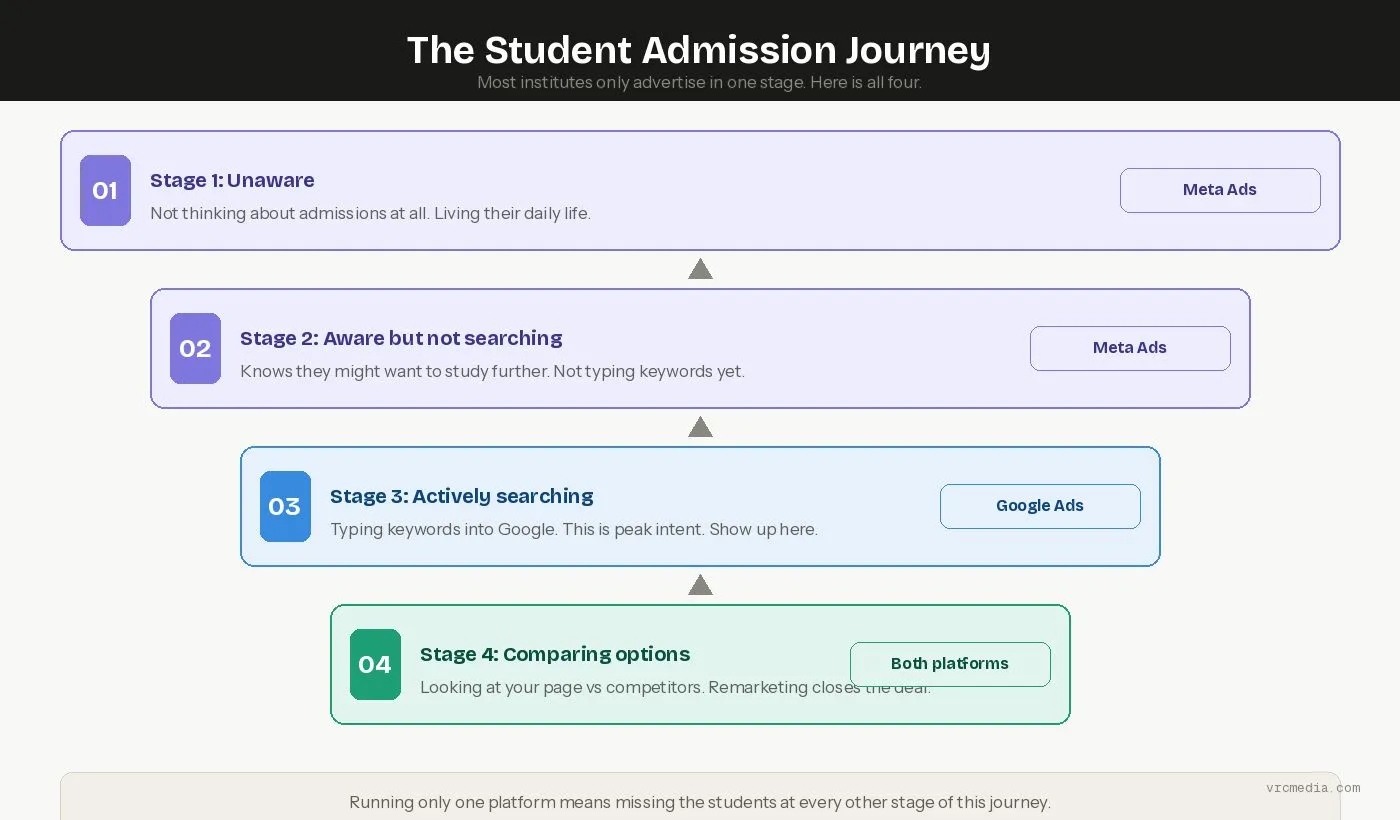
There are four stages. Most institutes only advertise in one of them and wonder why their cost per lead is high.
Stage 1: Unaware. The student has not thought about joining your type of course at all. They are living their life. Meta Ads lives here. You plant the seed.
Stage 2: Aware but not searching. They know they might want to do an MBA or study abroad, but they have not started looking. Meta Ads keeps you top of mind.
Stage 3: Actively searching. They are typing keywords into Google. This is where Google Ads pays off. The student has intent. You just need to show up.
Stage 4: Comparing options. They are looking at your landing page, your fees page, your testimonials. This is where your CRO and remarketing (both platforms) finish the job
Google Ads for education institutes: when it works and when it does not
Google Ads works on keywords. A student types something, Google decides which ads to show, and you pay when someone clicks.
For education institutes, the strongest keyword categories are:
“MBA college in [city]”, “NEET coaching near me”, “study abroad consultancy [city]”, “best engineering college [state]”, “IELTS coaching fees” and similar.
These are bottom-of-funnel searches. The student knows what they want. They are comparing you against two or three competitors. Your ad is one of the first four results they see.
The cost per click in education keywords in India ranges from Rs 30 to Rs 200 depending on the course and city. Competitive niches like MBA and study abroad in metro cities will be on the higher end.
Where Google Ads wins for institutes:
It wins when search volume exists for your course type and city. If people are already typing for what you offer, Google captures that intent beautifully. It also wins when your admissions window is short because Google delivers results fast. Run a campaign and you can get form fills within 48 hours.
Where Google Ads struggles:
It struggles when your course is new or niche and no one is searching for it yet. If you are a first-generation institute or a new program, there is no existing demand to harvest. Google gives you nothing to work with.
It also struggles when your budget is very tight. You cannot dominate a competitive keyword in Ahmedabad or Mumbai for Rs 5,000 a month. You will get outbid by bigger institutes and your ads will barely show.
Meta Ads for education institutes: when it works and when it does not
Meta Ads works on audiences. Instead of waiting for someone to search, you go to where students already are and show them something they find interesting or relevant.
The strength of Meta is its targeting depth. You can reach:
Students aged 18 to 25 in a specific city who have shown interest in higher education, parents aged 35 to 50 who follow education pages, working professionals aged 25 to 35 interested in MBA or upskilling, or people who have visited your website but not filled the form.
The creative does most of the heavy lifting on Meta. A dull ad with great targeting still fails. A good video creative showing student life, placement records, or a teacher explaining something useful will outperform a static fee-chart image every time.
Where Meta Ads wins for institutes:
It wins during pre-admission season when you want to build awareness before Google search volume picks up. Students are not yet typing keywords but they are absorbing information. Plant your name early.
It wins for remarketing. Students who visited your website and left are one of the most valuable audiences on Meta. A well-crafted retargeting ad can bring back 15 to 20% of those visitors.
It wins for courses with visual appeal, meaning courses with tangible outcomes like placement records, campus life, student transformations, or career outcomes. These tell well as video or carousel on Instagram and Facebook.
Where Meta Ads struggles:
It struggles when the institute has no creative assets. Running Meta without good photos, videos, or at minimum well-designed static creatives is like trying to make chai without tea. The platform rewards quality creative hard.
It also struggles when the lead quality expectation is very high right from day one. Meta leads tend to be warmer prospects who need a good counsellor follow-up process. If your team is not doing follow-ups well, Meta leads will seem low quality even when they are not.
The numbers: what to expect from each platform
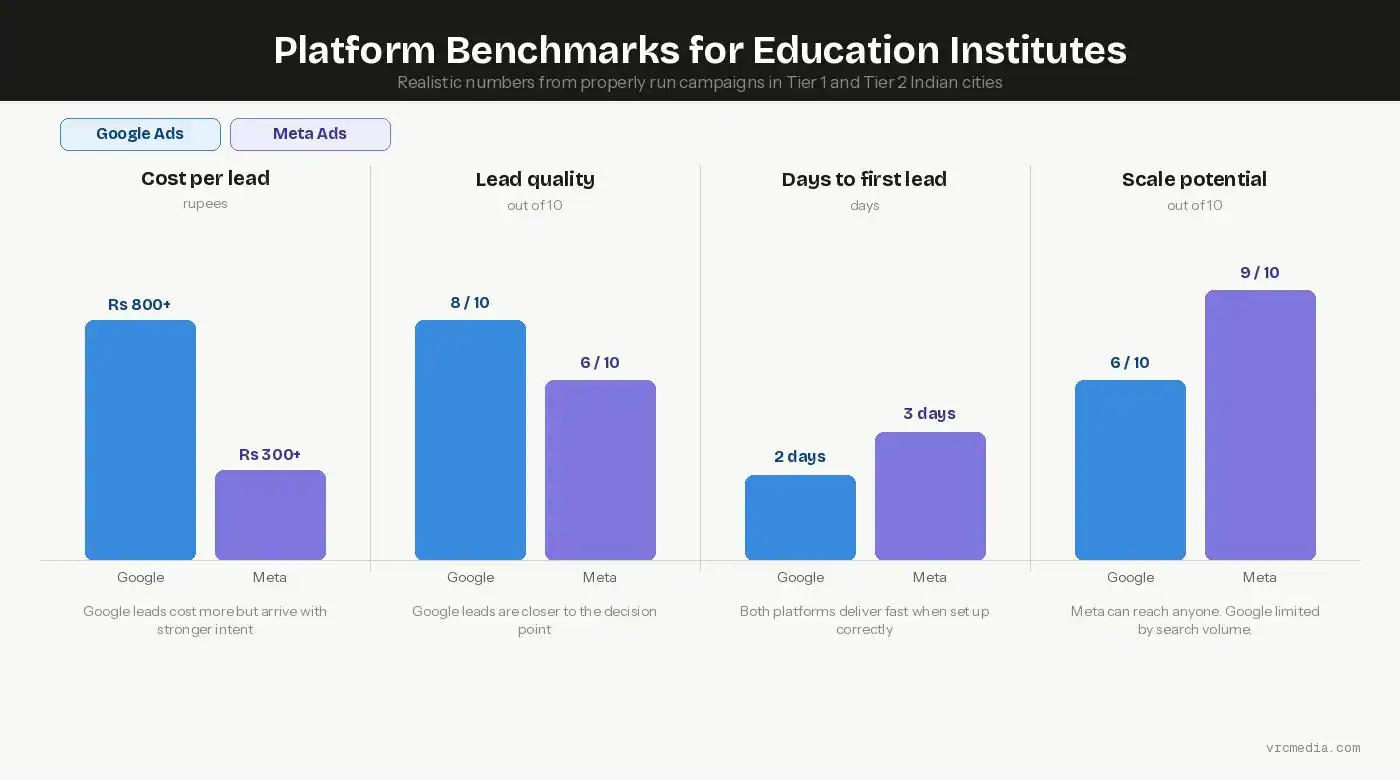
These are realistic benchmarks for education institutes in Tier 1 and Tier 2 Indian cities based on properly run campaigns. Your actual numbers will vary based on course, city, creative quality, and landing page.A quick read of those numbers: Google leads are more expensive but arrive with stronger intent. Meta leads are cheaper but need more counsellor effort. The scale potential on Meta is higher because you are not limited by how many people are searching. You can reach anyone in your target demographic.
The big mistake: running only one platform
Most institutes pick one and run with it. That is the mistake.
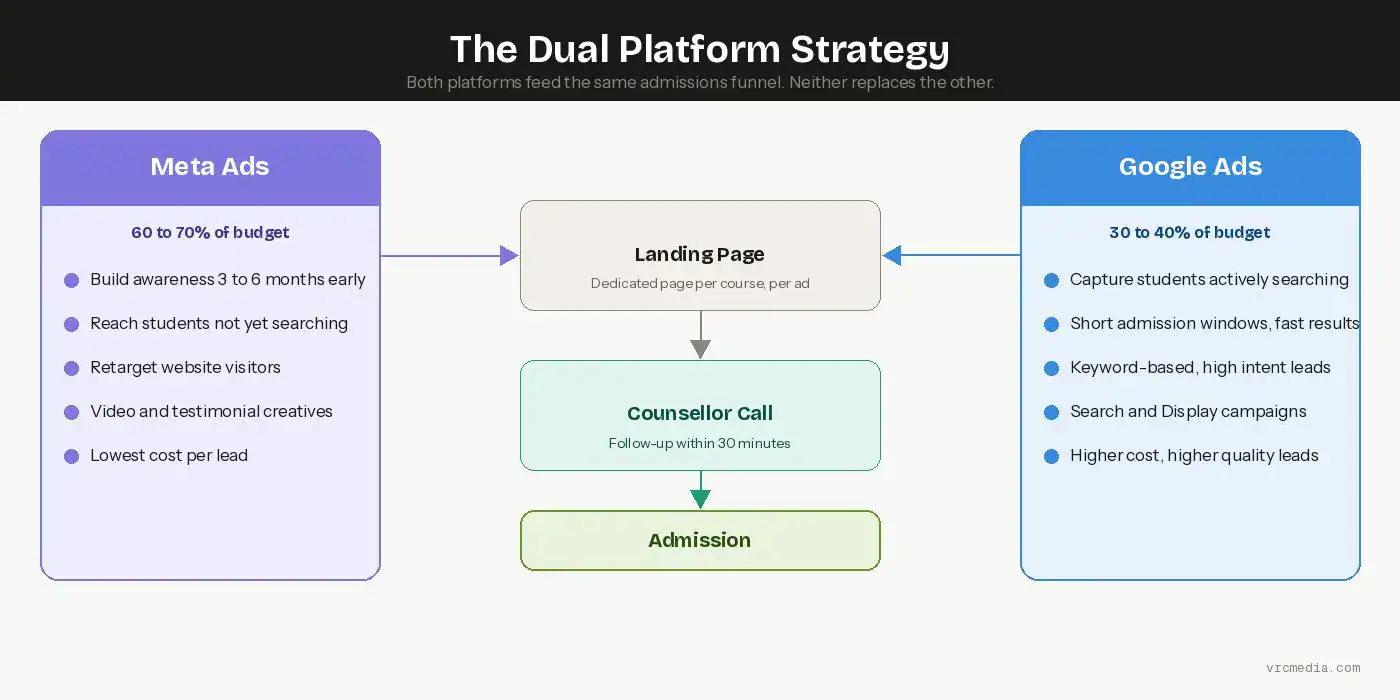
Google captures students who are ready now. Meta builds a pipeline of students who will be ready in 30 to 90 days. If you run only Google, you have no pipeline for future batches. If you run only Meta, you miss the students who are actively searching right now and might join a competitor today.
The smartest approach is to run both with different budgets and different expectations.The 60 to 40 split is a starting point, not a rule. For newer institutes with no brand recognition, lean more toward Meta to build familiarity. For institutes in competitive cities where search volume is high (MBA in Pune, coaching in Kota, IELTS in Ahmedabad), Google Ads deserves a higher share.
Which platform is right for your situation
Use this as a guide, not a rule. Your budget, course type, and city will shape the final call.
Choose Google Ads first if:
Your course category has strong search volume in your city. You are in a competitive segment where students actively compare options online. You have a short admission window of 30 to 60 days and need results fast. Your budget is Rs 15,000 or above per month so you can bid competitively.
Choose Meta Ads first if:
You are a new institute or new course with no established brand. Your target demographic is active on Instagram and Facebook, meaning 18 to 30 year olds. Your admissions cycle is long and you want to warm up students 3 to 6 months before the intake. You have good photos, videos, or student testimonial content to use as creatives.
Use both if:
You have a monthly budget of Rs 30,000 or above and want a consistent pipeline across the entire admission cycle. You want to build long-term brand awareness while also capturing immediate searches.
The creative rule that changes everything on Meta
On Google, the keyword does most of the work. You write a clear headline, match it to what the student searched, and send them to a relevant landing page.
On Meta, creative is everything. The same audience will respond completely differently to different creatives.
What works for education institutes on Meta, based on what consistently outperforms:
Student testimonial videos of 30 to 60 seconds perform better than any designed banner. A student holding their phone and talking about their experience, placement, or college life outperforms a professionally shot brochure video almost every time.
Before and after framing works well. “I was working a 22,000 rupee job. After the MBA program, I got placed at 52,000.” That one line as a static ad with the student’s photo pulls strong.
Social proof in the headline. “412 students placed in 2024” or “Ranked Top 10 by [publication]” in the headline stops the scroll.
Reels and short video get far cheaper reach than static images right now on Instagram and Facebook. If you are not making short videos for your institute, you are paying more for every impression than you need to.
The landing page error that wastes ad budget on both platforms
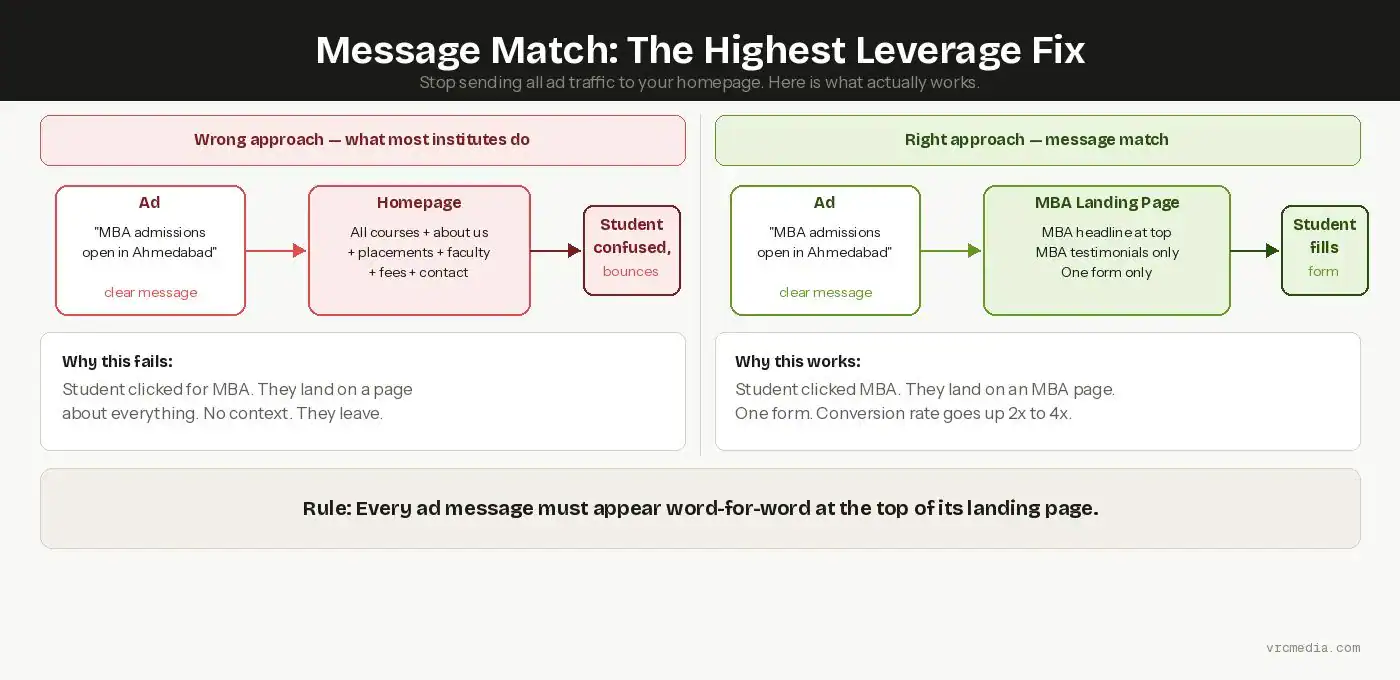
You can run perfect ads and still get terrible results if you send students to the wrong page.
The most common mistake: sending all ad traffic to the homepage.
Your homepage is designed to inform everyone about everything. It is not designed to convert one specific student looking for one specific thing.
If your Google Ad says “MBA admissions open in Ahmedabad”, the landing page should say “MBA admissions open in Ahmedabad” at the top. Same message. Same course. A single form. No distractions.
If your Meta Ad shows a student testimonial about the study abroad program, the landing page should have another testimonial, the program details, and one form. Not your entire course catalogue.
This is called message matching and it is one of the highest leverage improvements any institute can make without changing their ad spend at all.—
The quick decision framework
If you are still unsure, answer these three questions:
Do students actively search for your course type in your city? If yes, start with Google Ads.
Do you have good creative assets including photos, videos, or testimonials? If yes, Meta Ads will reward you well.
Is your admissions cycle longer than 60 days? If yes, you need Meta Ads for pipeline building regardless of your Google strategy.
If all three answers are yes, you should be running both.
What to do next
The biggest waste we see with education institutes is spending Rs 20,000 to Rs 50,000 per month on ads with no proper structure: no message matching on landing pages, no retargeting, no creative testing on Meta, and no negative keyword lists on Google.
That is not a platform problem. That is an execution problem.
If you want us to look at your current ad account and tell you exactly where the money is leaking, we do a free 30 minute audit for education institutes. No commitment. Just clarity.
Book your free audit at vrcmedia.com.
VRC Media is a performance marketing agency based in Ahmedabad. We work with coaching institutes, study abroad consultancies, and private education institutes across India on Meta Ads, Google Ads, and CRO.
